Lignocellulose is the structural material of every tree and most plants: cellulose, hemicellulose and lignin. It is the largest renewable carbon pool on land, it is abundant in Europe as a residue stream, and it contains exactly the aromatic and polyol structures that surfactant chemistry needs. The reason it has not displaced palm and petroleum is not chemistry, it is process economics.
- Components
- Cellulose, hemicellulose, lignin
- Carbon pool
- Largest renewable terrestrial source
- Land use
- Residue-based, no food competition
- PureSurf scale
- 50 kg per batch
What lignocellulose offers a chemist
Cellulose and hemicellulose are polysaccharides, so they deliver sugar-based polyols that make excellent hydrophilic head groups. Lignin is an aromatic polymer, which is unusual and valuable: it is one of very few renewable sources of aromatic carbon, a structure that petroleum otherwise supplies.
That combination means a single residue stream can supply both halves of an amphiphile: the water-loving head and, after suitable conversion, the hydrophobic backbone.
Why it is hard
Lignocellulose is deliberately robust. Plants evolved it to resist microbial attack, and that recalcitrance is exactly what makes fractionation difficult. Separating the three components without destroying them requires selective processing, and lignin in particular is structurally heterogeneous, which complicates reproducible synthesis.
- Recalcitrance: the matrix resists mild fractionation.
- Heterogeneity: lignin structure varies by species and process.
- Purity: residual sugars and ash affect downstream catalysis.
- Economics: process intensity has to stay below the value of the product.
How the PureSynth platform handles it
PureSurf operates a catalytic, solvent-lean conversion route that turns renewable European building blocks into surfactant actives with controlled chain length and head group chemistry. More than 80 novel compounds were synthesised and screened to identify the grades that combine performance with a clean toxicological profile.
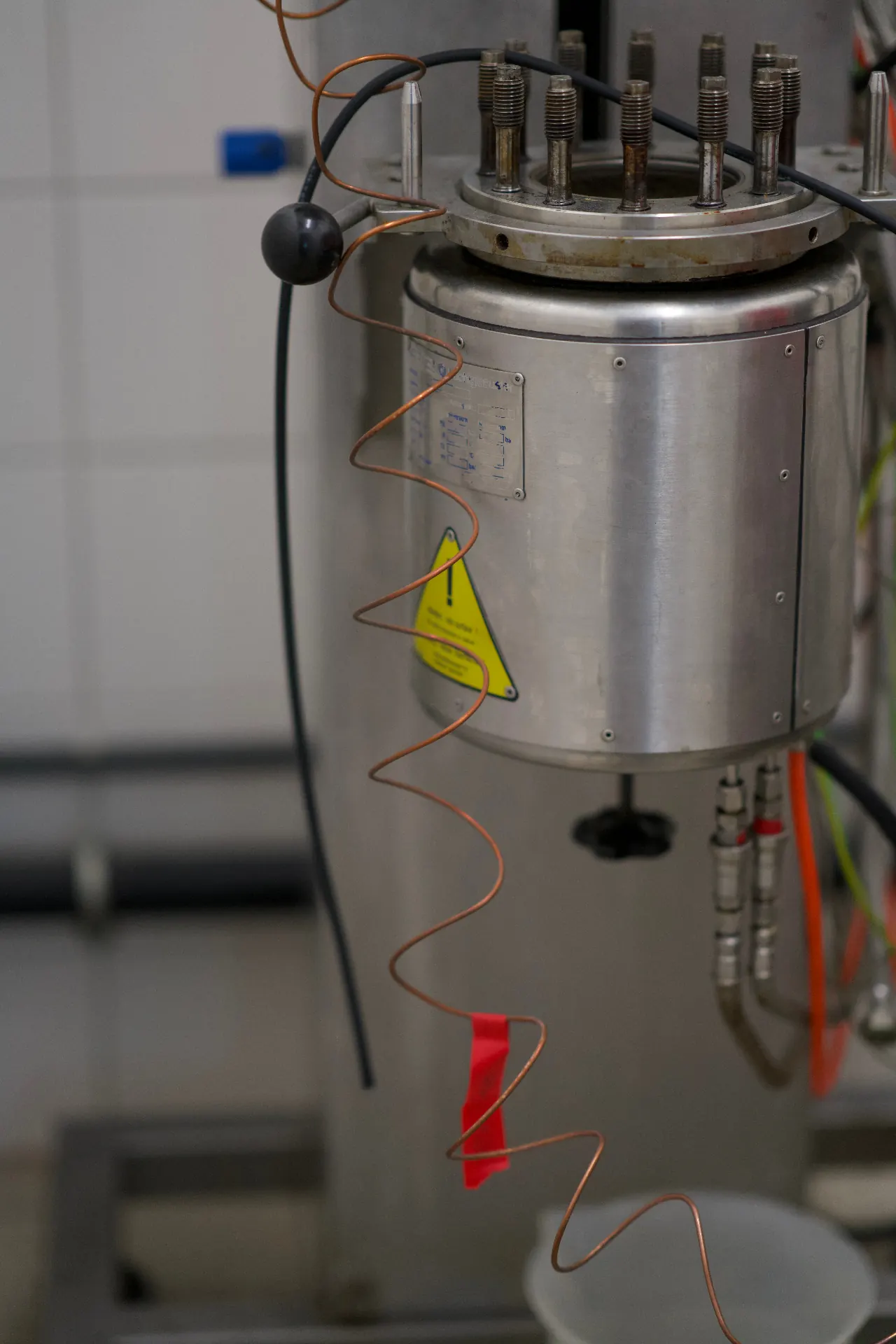
The platform has been scaled from laboratory grams to 50 kg per batch in under two years, and the underlying chemistry is protected by 4 patent families across more than 8 jurisdictions with a clean freedom-to-operate position.
What comes out at the end
The commercial output is NEXOVANT, a bio-based amine oxide surfactant. Independent benchmarking at BASF SE measured a CMC of 33 mg/L for NEXOVANT F Pro against 73 mg/L for the C12-C14 amine oxide benchmark, both measured by BASF SE, with an interfacial tension against olive oil of 0.69 mN/m versus 5.52 mN/m for that benchmark.
Environmental data follows the same discipline. Environmental data is stated per grade: NEXOVANT F Eco meets the ready-biodegradability criterion (74.7 % ThCO₂ in 28 days, OECD 301B, GLP), while F Pro is under final assessment. Aquatic toxicity is reported as registered EC50 values under OECD 201 (algae, 72 h) and OECD 202 (Daphnia magna, 48 h) rather than as a multiplier, and the CLP classification is stated per grade. Alongside it, RHEOSYL reaches 7.0×10³ mPa·s as an additive-free gelator and SYLVAXIS meets DIN EN 1276, both currently at TRL 4.
Frequently asked questions
Does lignocellulose compete with food crops?
Residue-based lignocellulose does not. It uses material that is already a by-product of forestry and agriculture rather than dedicated food production.
Is lignin usable in surfactants?
Yes, as a renewable source of aromatic carbon. Its structural heterogeneity is the main technical challenge, which is why selective catalytic conversion matters.
Has the process been demonstrated beyond the laboratory?
It has been scaled from laboratory grams to 50 kg per batch in under two years, supported by an EIC Transition grant under Horizon Europe (grant agreement 101058142).
Content last reviewed: by Prof. Katalin Barta Weissert
Part of this topic cluster
Bio-based surfactants: the full pillar overviewRelated topics in this cluster
Evidence from our own portfolio: Compare the NEXOVANT, RHEOSYL and SYLVAXIS grade data