Anionic surfactants carry a negatively charged head group in water. They are the highest-volume surfactant class worldwide because they combine strong detergency with abundant foam at a low raw-material cost. They are also the class most exposed to hard water, skin-irritation scrutiny and feedstock questions, which is why most modern formulations pair them with non-ionic or amphoteric partners.
- Head group charge
- Negative in aqueous solution
- Typical chemistries
- Sulfates, sulfonates, carboxylates, phosphates
- Strengths
- Detergency, foam volume, cost
- Weaknesses
- Hard-water sensitivity, irritation potential
How anionic surfactants work
The hydrophilic end of an anionic surfactant dissociates in water and leaves a negative charge on the molecule, balanced by a counter-ion such as sodium, potassium or ammonium. That charge produces strong electrostatic repulsion between molecules and between soil particles, which is exactly what keeps loosened dirt suspended in the wash liquor instead of redepositing on the fabric.
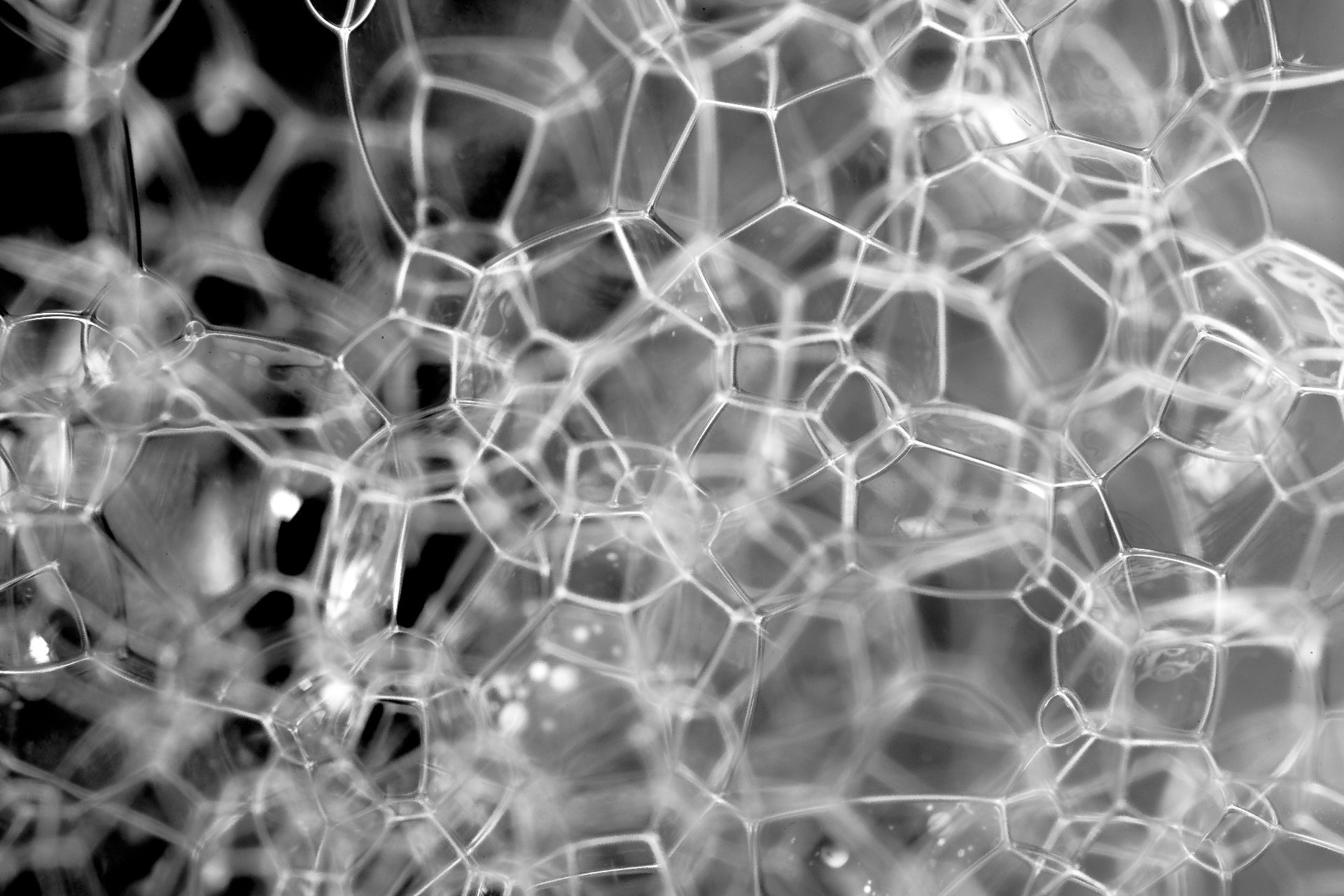
The same repulsion stabilises the thin liquid films between air bubbles, which is why anionic surfactants foam so readily. Foam has little to do with cleaning performance in a physical sense, but it is a strong consumer signal, so anionic chemistry remains dominant in hand dishwash, shampoo and laundry liquids.
- Detergency: removal and suspension of particulate and oily soil.
- Foam: high volume, fast build, moderate stability.
- Emulsification: effective on non-polar oils at moderate dose.
- Anti-redeposition: charge repulsion keeps soil in solution.
The main anionic chemistries
Anionic surfactants are grouped by the acidic function that carries the charge. Each family sits at a different point on the performance, mildness and cost curve.
| Sulfates | Alkyl sulfates and alkyl ether sulfates (SLS, SLES). High foam, high detergency, widely used in personal care and dishwash. |
|---|---|
| Sulfonates | Linear alkylbenzene sulfonate (LAS), alpha-olefin sulfonate. Cost-efficient laundry detergency, good hard-water tolerance for the class. |
| Carboxylates | Classic soaps and ether carboxylates. Mild, pH sensitive, prone to precipitation in hard water. |
| Phosphates | Alkyl phosphate esters. Industrial cleaning, emulsion polymerisation, corrosion inhibition. |
| Isethionates and taurates | Mild, syndet bar and facial cleanser chemistry, higher raw-material cost. |
Where anionic surfactants reach their limits
Calcium and magnesium ions in hard water bind to the anionic head group and form poorly soluble salts. That removes active surfactant from solution and, in the case of soaps, produces visible scum. Formulators compensate with chelating builders, higher dose or a shift toward non-ionic partners.
Anionic surfactants also bind readily to skin proteins, which is the mechanism behind the irritation profile of high-sulfate cleansers. And because many high-volume anionics derive from petrochemical or palm-based feedstocks, they carry both price volatility and supply-chain scrutiny.
- Sensitive to calcium and magnesium: performance drops in hard water.
- Incompatible with cationic surfactants: opposite charges form insoluble complexes.
- Higher irritation potential than non-ionic and amphoteric classes.
- Feedstock exposure: fossil price volatility or palm-oil certification pressure.
Bio-based alternatives and blending strategy
The practical answer is rarely to replace the anionic surfactant outright. It is to reduce its share and let a high-performance non-ionic carry more of the work, which lowers total actives, improves hard-water robustness and softens the irritation profile.
NEXOVANT is a bio-based amine-oxide surfactant designed for exactly that role. Independent benchmarking at BASF SE measured a critical micelle concentration of 33 mg/L for NEXOVANT F Pro against 73 mg/L for the C12 to C14 amine oxide benchmark, and an interfacial tension against olive oil of 0.69 mN/m versus 5.52 mN/m. A lower CMC means the co-surfactant reaches full effect at a smaller dose, so the anionic content can come down without losing cleaning power.
Frequently asked questions
What is an anionic surfactant?
A surfactant whose hydrophilic head group carries a negative charge in water, balanced by a counter-ion such as sodium. Sulfates, sulfonates, soaps and phosphate esters are the main families.
Which surfactants are anionic?
Sodium lauryl sulfate (SLS), sodium laureth sulfate (SLES), linear alkylbenzene sulfonate (LAS), alpha-olefin sulfonate, soaps (fatty acid salts), alkyl phosphate esters, isethionates and taurates.
Why do anionic surfactants perform poorly in hard water?
Calcium and magnesium ions bind the negatively charged head group and form poorly soluble salts. The surfactant leaves the solution, so effective active concentration and cleaning performance drop.
Can anionic and cationic surfactants be combined?
Generally no. The opposite charges attract and form insoluble complexes that precipitate. Anionic surfactants are combined with non-ionic or amphoteric surfactants instead.
Content last reviewed: by Prof. Katalin Barta Weissert
Part of this topic cluster
Bio-based surfactants: the full pillar overviewRelated topics in this cluster
Evidence from our own portfolio: See NEXOVANT's measured CMC and interfacial tension data