In short
Critical micelle concentration (CMC) is the surfactant concentration above which added molecules assemble into micelles instead of further lowering surface tension. A lower CMC means micelle-driven effects such as detergency and solubilisation start at a lower dose, which is why CMC is reported alongside the method, temperature and electrolyte content used to measure it.
Every surfactant molecule has a hydrophilic head and a hydrophobic tail, and in dilute solution those molecules sit mostly at interfaces, air-water or oil-water, reducing surface and interfacial tension as concentration rises. Past a specific concentration, the interfaces become saturated and additional molecules instead aggregate into micelles, hydrophobic cores shielded from water by the head groups. That threshold is the critical micelle concentration. It is not a marketing figure; it is a measurable physical constant that depends on the molecule, the temperature, the electrolyte content and the measurement method, and it is one of the few numbers that ties directly to how much surfactant a formulation actually needs.
- NEXOVANT F Pro CMC
- 33 mg/L (BASF SE, third-party)
- Benchmark CMC
- 73 mg/L, C12-C14 amine oxide, same laboratory
- Interfacial tension vs olive oil
- 0.69 mN/m (F Pro) vs 5.52 mN/m benchmark
- Typical CMC range
- Roughly 0.05 to 10 mmol/L across surfactant classes
What a micelle is, and what happens at the CMC
Below the CMC, surfactant molecules dissolve as free monomers and migrate to any available interface, which is why surface tension drops steadily as concentration increases from zero. Once the interfaces are saturated, the system has nowhere left to put more molecules except into the bulk, and monomers start self-assembling into micelles, typically spherical at first, with the hydrocarbon tails pointing inward and the polar or ionic heads facing the surrounding water.
Above the CMC, adding more surfactant mostly builds more micelles rather than lowering surface tension further, which is why a plot of surface tension against concentration shows a sharp bend at the CMC and then flattens out. Micelles are what carry out solubilisation of oils and soils, so many of the properties a formulator cares about, cleaning power, foam stabilisation, emulsification, only switch on once the CMC is passed.
Why a lower CMC can mean a lower dose
Because micelle-forming behaviour starts at the CMC, a surfactant with a lower CMC reaches its functional onset at a lower use concentration than one with a higher CMC, all else being equal. That is a statement about where the threshold sits, not a guarantee of proportional savings: real formulations contain multiple surfactants, builders and other actives that interact, and the working concentration in a finished product is set by overall performance testing, not by CMC alone.
Even with that caveat, CMC is a legitimate first filter when comparing candidate surfactants for a reformulation. A molecule that forms micelles at a fraction of the concentration required by an incumbent is a reasonable candidate for a dose-reduction trial, and a lower use concentration is one of the few input factors a formulator can influence without invented percentages attached to it.
How CMC is measured
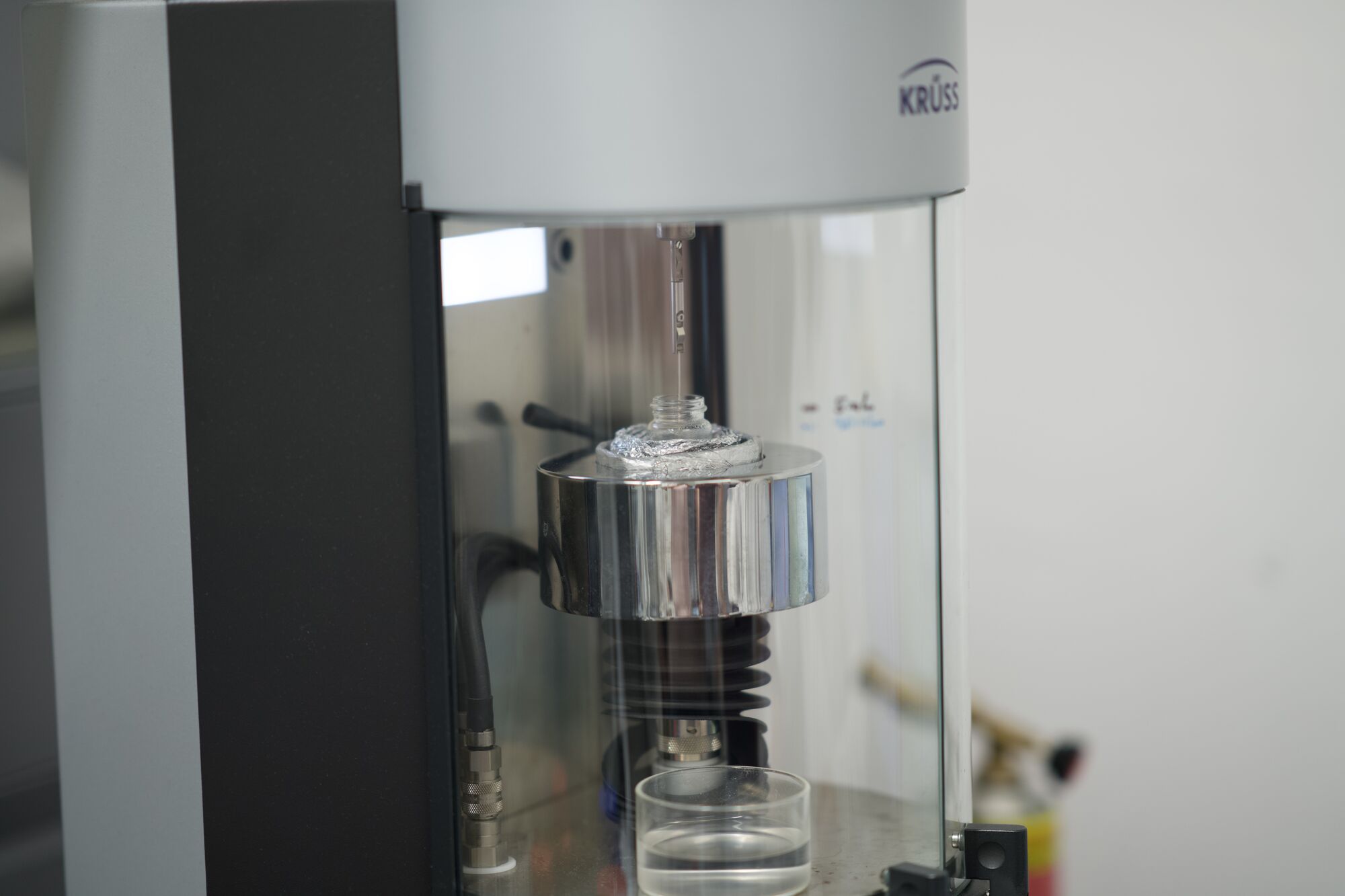
Several independent methods detect the same underlying inflection and are used depending on the surfactant type and what else needs to be known about the system. Surface or interfacial tensiometry, using a Wilhelmy plate or a du Nouy ring, plots tension against concentration and locates the break point; it is the most widely reported method because it also yields the interfacial tension value itself, not just the CMC.
Conductivity measurements work well for ionic surfactants, since the slope of conductivity against concentration changes once micelles start binding counter-ions. Fluorescence probe methods, commonly using pyrene, track a probe whose emission spectrum shifts once it partitions into a micelle core; dynamic light scattering (DLS) detects the appearance of micelle-sized particles directly; and isothermal titration calorimetry (ITC) reads the heat signature of micelle formation and additionally yields thermodynamic parameters.
| Tensiometry (Wilhelmy plate, du Nouy ring) | Surface/interfacial tension vs concentration; gives CMC and the tension value |
|---|---|
| Conductivity | Best suited to ionic surfactants; slope change at the CMC |
| Fluorescence probe (pyrene) | Emission ratio shift as the probe partitions into micelles |
| Dynamic light scattering (DLS) | Direct detection of micelle-sized aggregates in solution |
| Isothermal titration calorimetry (ITC) | Heat signature of micellisation, plus thermodynamic parameters |
Why method, temperature, electrolyte, pH and purity all belong on the label
CMC is not a fixed property of a molecule; it shifts with the conditions the measurement was taken under. Temperature moves the CMC of most surfactants, electrolyte addition lowers the CMC of ionic surfactants by screening head-group charge, pH changes the ionisation state of pH-sensitive head groups such as amine oxides, and even small amounts of impurity, particularly more hydrophobic homologues, can pull the apparent CMC down or blur the inflection point.
A CMC figure quoted without its measurement method, temperature, electrolyte background, pH and sample purity is not comparable to any other figure, including a competitor value. That is why a credible technical data sheet states all five alongside the number, and why the PureSurf figures on this page are reported with their measuring laboratory and conditions rather than as a bare value.
Typical CMC ranges by surfactant class
CMC varies by roughly two orders of magnitude across surfactant chemistries and chain lengths, and no single number represents an entire class. As a general pattern, anionic surfactants such as alkyl sulfates and sulfonates tend to sit at the higher end because of head-group charge repulsion, non-ionic surfactants such as alcohol ethoxylates and amine oxides tend to sit at the lower end because there is no charge to overcome, cationic surfactants fall in a broad middle range depending on chain length, and amphoteric surfactants such as betaines vary widely depending on the balance of charges in the head group.
Within any class, CMC drops as the hydrophobic chain lengthens, because a longer tail favours aggregation. This is industry-level context, not a substitute for a measured value: any specific surfactant, PureSurf included, should be compared on its own reported figure and conditions rather than on a class average.
| Class | Typical CMC order of magnitude | Driving factor |
|---|---|---|
| Anionic (sulfates, sulfonates) | Higher end of the range | Head-group charge repulsion resists aggregation |
| Non-ionic (ethoxylates, amine oxides) | Lower end of the range | No charge to overcome, aggregation is easier |
| Cationic (quaternary ammonium) | Broad middle range | Depends strongly on alkyl chain length |
| Amphoteric (betaines) | Wide range | Net charge depends on pH and co-surfactants |
These are generic, industry-level ranges intended for orientation only. They contain no brand-specific figures and should not be read as a claim about any named product.
Krafft point and cloud point: related but different thresholds
CMC is often discussed alongside two other thresholds that describe different behaviour. The Krafft point is the temperature below which an ionic surfactant does not dissolve well enough to reach its own CMC, so at low temperature the surfactant can precipitate rather than form micelles; below the Krafft point, reported CMC values may not be physically reachable in practice.
The cloud point applies mainly to non-ionic surfactants: above a certain temperature, the surfactant-rich solution separates into two phases as the head groups lose hydration. Neither the Krafft point nor the cloud point replaces CMC as a measure of micellisation, but both define the temperature window within which a stated CMC is actually meaningful for a given formulation.
The PureSurf benchmark: NEXOVANT F Pro against a C12-C14 amine oxide
NEXOVANT F Pro was measured by BASF SE at a CMC of 33 mg/L, against 73 mg/L for a conventional C12-C14 amine oxide benchmark measured in the same laboratory under the same protocol. The same third-party study measured interfacial tension against olive oil at 0.69 mN/m for F Pro versus 5.52 mN/m for the benchmark, an interfacial tension up to 8 times lower than the benchmark surfactants tested.
Reporting both figures from a single laboratory matters because it removes the largest source of CMC noise: differing methods, temperatures or electrolyte backgrounds between two datasets. A lower CMC measured under identical conditions is a direct, apples-to-apples signal that F Pro reaches micelle-driven performance at a materially lower concentration than the benchmark it was tested against.
| Parameter | NEXOVANT F Pro | C12-C14 amine oxide benchmark |
|---|---|---|
| CMC | 33 mg/L | 73 mg/L |
| Interfacial tension vs olive oil | 0.69 mN/m | 5.52 mN/m |
Both figures are from the same third-party laboratory, BASF SE, under the same test protocol. No toxicity or biodegradation multiplier is implied by this comparison; those are separate, independently reported endpoints.
How to evaluate a CMC figure from a supplier
A CMC number on a data sheet is only as useful as the conditions behind it. Before using a supplier figure to compare surfactants or justify a dose change, ask for enough detail to reproduce or at least sanity-check the measurement.
- Which method was used: tensiometry, conductivity, fluorescence probe, DLS or ITC?
- What temperature was the measurement taken at, and does it match your process temperature?
- Was the measurement made in deionised water or in a formulation-relevant electrolyte background?
- At what pH was the surfactant tested, especially for pH-sensitive head groups such as amine oxides?
- What was the sample purity, and were homologues or unreacted intermediates present?
- Was the CMC measured by an independent third-party laboratory, or is it an internal figure?
- Is the interfacial tension value reported against a relevant oil phase, or only surface tension against air?
- Is the benchmark surfactant it is compared against named, and was it measured in the same study?
Evaluating NEXOVANT for your formulation
A CMC comparison is a starting point for a dose-reduction trial, not a substitute for one. Because real formulations combine multiple surfactants, builders and rheology modifiers, the practical way to use a lower CMC is to run a side-by-side trial at matched active content, then step the dose down while re-checking cleaning performance, foam, viscosity and stability at each level.
PureSurf shares the full study reference behind the figures on this page, including the BASF SE measurement conditions, and supplies technical data sheets alongside samples so formulation teams can verify the numbers directly in their own systems.
Frequently asked questions
What does CMC stand for in surfactant chemistry?
CMC stands for critical micelle concentration, the concentration above which surfactant molecules in solution start forming micelles instead of continuing to lower surface tension. It is measured in units such as mg/L or mmol/L and is specific to a given molecule, temperature and solution background.
What happens physically at the CMC?
Below the CMC, surfactant monomers accumulate mainly at interfaces such as air-water, steadily reducing surface tension. At the CMC, those interfaces are saturated and additional molecules self-assemble into micelles in the bulk solution instead, which is why surface tension flattens out just above the CMC.
How is CMC measured?
Common methods include surface or interfacial tensiometry with a Wilhelmy plate or du Nouy ring, conductivity measurements for ionic surfactants, fluorescence probe methods using pyrene, dynamic light scattering, and isothermal titration calorimetry. Each detects the same underlying transition from a different physical signal.
Does a lower CMC always mean a lower use dose in a formulation?
A lower CMC means micelle-driven behaviour starts at a lower concentration, which makes a lower use dose plausible and worth testing. It is not a guarantee, because finished formulations contain multiple ingredients that interact, so the final dose should be set by performance testing, not by CMC alone.
What is NEXOVANT F Pro’s CMC compared to a conventional amine oxide?
NEXOVANT F Pro was measured by BASF SE at a CMC of 33 mg/L, compared with 73 mg/L for a C12-C14 amine oxide benchmark measured in the same laboratory. The same study measured interfacial tension against olive oil at 0.69 mN/m for F Pro versus 5.52 mN/m for the benchmark.
What is the difference between CMC and Krafft point?
CMC is the concentration threshold for micelle formation at a given temperature. The Krafft point is a temperature threshold, the point below which an ionic surfactant cannot dissolve well enough to reach its own CMC. Below the Krafft point, micelle formation may not occur regardless of concentration.
Why do CMC values from different sources disagree?
CMC shifts with temperature, electrolyte content, pH and sample purity, and different measurement methods can locate the inflection point slightly differently. A CMC value reported without those conditions cannot be compared reliably to a value measured under different conditions or by a different method.
Do all surfactants have a similar CMC?
No. CMC varies by roughly two orders of magnitude across surfactant classes and chain lengths. Anionic surfactants tend to sit at the higher end because of head-group charge repulsion, while non-ionic surfactants such as amine oxides tend to sit lower, and CMC generally drops as the hydrophobic chain lengthens within any class.
Content last reviewed: by Prof. Katalin Barta Weissert
Part of this topic cluster
Bio-based surfactants: the full pillar overviewRelated topics in this cluster
Evidence from our own portfolio: See NEXOVANT's measured CMC and interfacial tension data